
Colorado Boulevard BRT Project Moves Toward Next Phase of Planning (Copy)
DENVER, CO — As construction continues on Denver’s East Colfax Bus Rapid Transit project, another major corridor is moving closer to receiving its own BRT transformation.
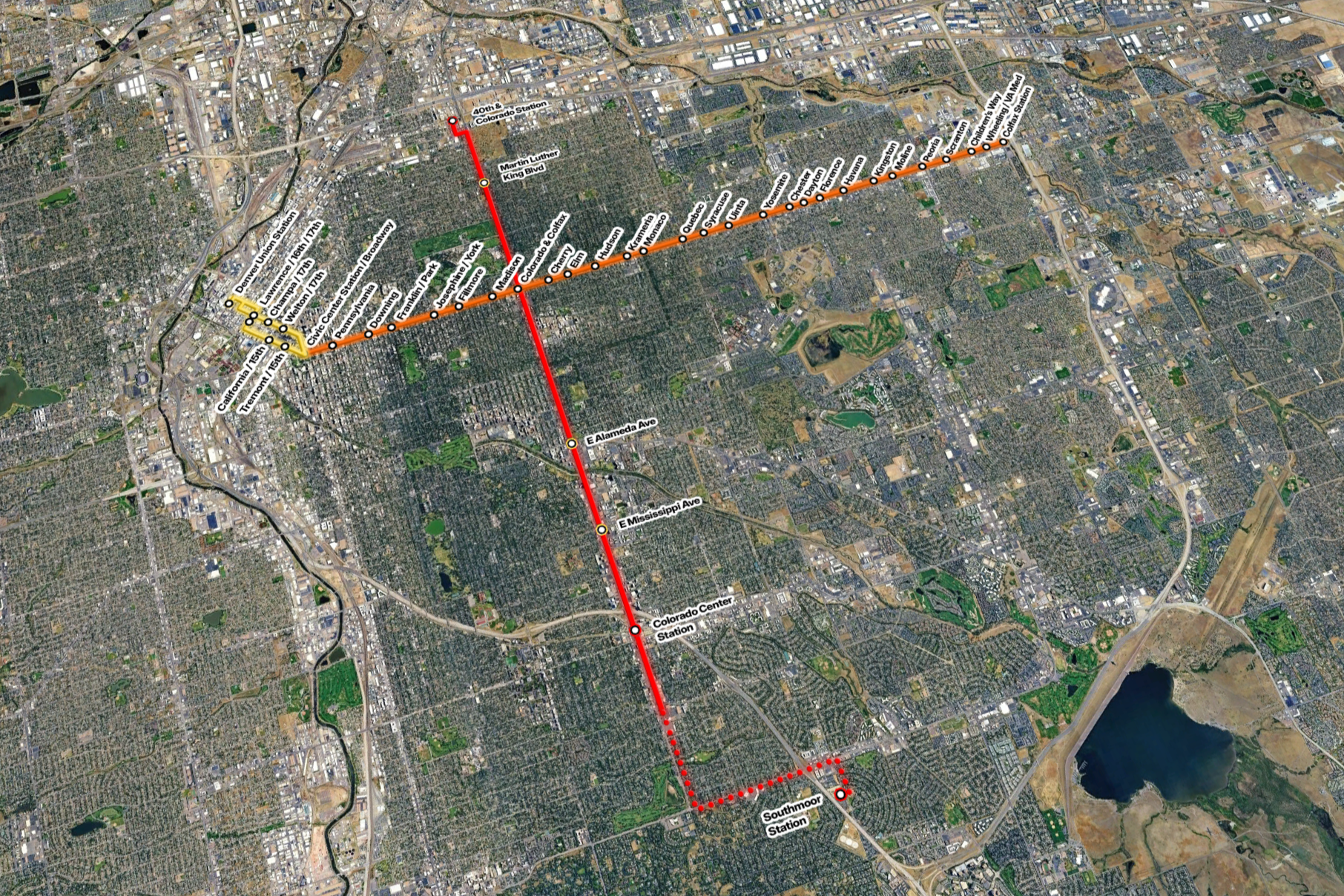
Colfax & Colorado BRT Project Lines
The Colorado Department of Transportation is advancing plans for Bus Rapid Transit along Colorado Boulevard, with a proposed route stretching from the area around Interstate 70 south to the Southmoor transit station beyond Hampden Avenue. The project would introduce faster and more reliable transit while also bringing a broader set of safety, pedestrian and accessibility improvements to one of Denver’s busiest north-south corridors.
CDOT is developing the project alongside the Regional Transportation District, City and County of Denver, Arapahoe County, City of Glendale and Denver Regional Council of Governments. As of 2026, the project remains in the alternatives analysis and environmental evaluation process, with the team working toward selecting a preferred configuration for the corridor.
The proposed BRT line would connect several important pieces of Denver’s existing and future transit network. Plans show connections with rail service at the 40th & Colorado, Colorado Center and Southmoor stations, along with future BRT connections around Martin Luther King Jr. Boulevard, East Colfax Avenue, East Alameda Avenue and East Mississippi Avenue.
Unlike a traditional bus route, BRT incorporates features commonly associated with rail transit. Those can include upgraded stations, level boarding, real-time arrival information, off-board fare payment, all-door boarding and dedicated transit lanes in portions of the corridor. The goal is to reduce delays and provide more consistent travel times while maintaining the flexibility of bus service.
Exactly how those buses will operate on Colorado Boulevard has not yet been finalized. CDOT is studying several configurations that could result in buses operating in a combination of center-running dedicated lanes, side-running dedicated lanes and mixed-traffic sections depending on the location. The earlier Colorado Boulevard Corridor Plan evaluated four broad options, including maintaining existing conditions, enhanced buses operating in mixed traffic, side-running BRT and center-running BRT.
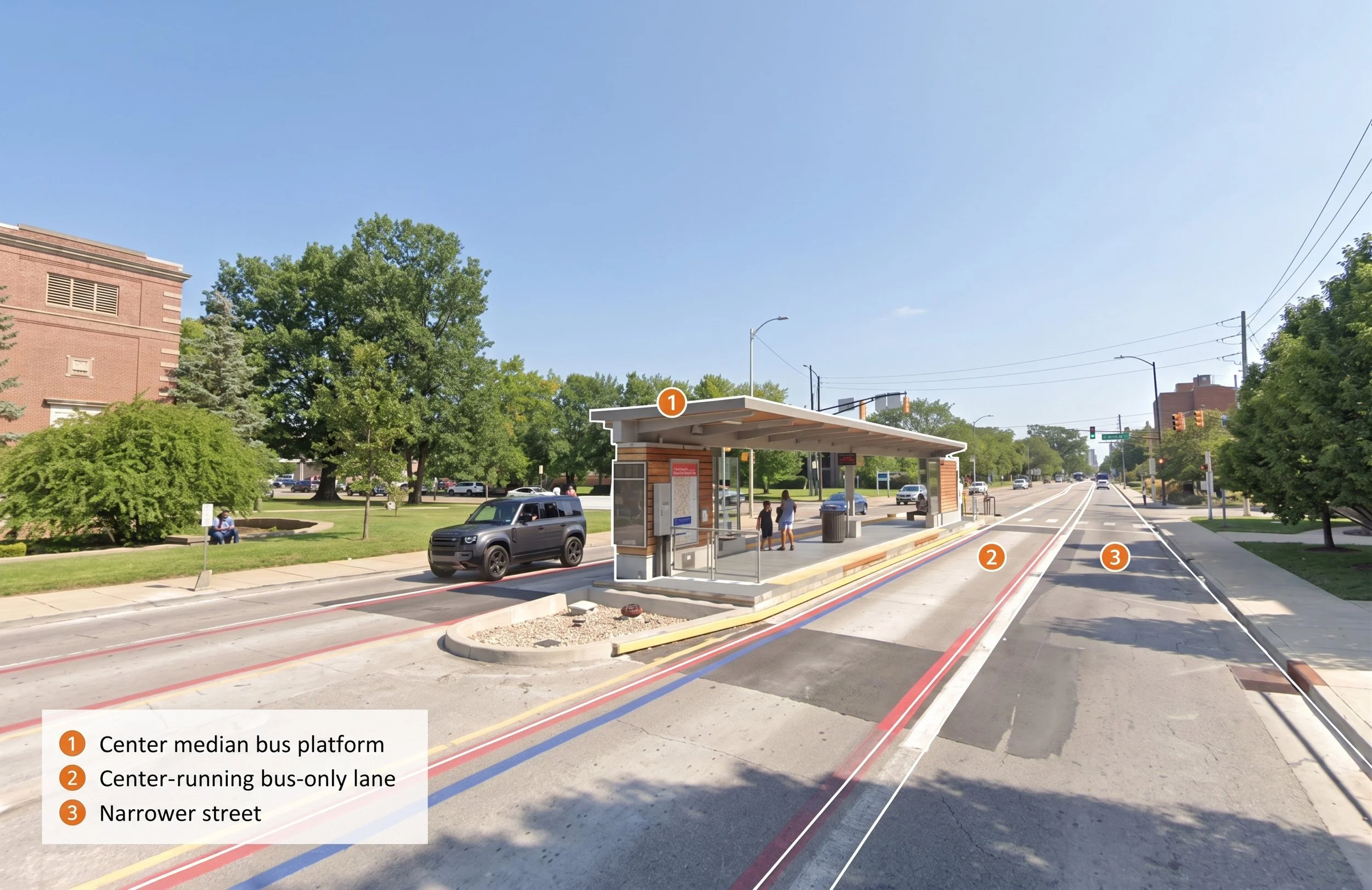
Example of Center Running BRT Bus Stop | Sourced from the Colorado Boulevard Corridor Plan
The project is also expected to extend beyond the transit service itself.
Colorado Boulevard currently has significant gaps in its pedestrian infrastructure, including approximately one mile of missing sidewalks and four miles of sidewalks that do not meet ADA standards. CDOT says the BRT project will establish a contiguous ADA-compliant sidewalk network along the corridor, while potential designs are also considering new or improved crosswalks, traffic signal changes and bicycle connections. Above-curb bike lanes and multi-use paths are among the options being studied, although final improvements have not yet been selected.
Safety is another major component of the project. Colorado Boulevard is part of Denver’s High Injury Network, and CDOT reports that 117 crashes along the corridor resulted in a death or serious injury between 2018 and 2022. At the same time, the corridor is already one of RTD’s higher-ridership bus routes, carrying approximately 3,000 riders per day despite buses regularly experiencing delays.
Those transportation demands are expected to increase. Planning documents project the population along the corridor to grow by 52% by 2050. Without improvements, travel times are projected to worsen by 35% during the morning commute and 25% during the evening commute.
The Colorado Boulevard project is part of a much larger effort to build a network of BRT corridors throughout the Denver metropolitan area. Colorado Boulevard is one of 11 BRT corridors identified in the region’s long-term transportation planning, eventually allowing riders to transfer between multiple high-frequency bus routes, rail lines and local transit services.
Funding is expected to come from a combination of federal, state and local sources. CDOT’s 10-year transportation plan includes a commitment for $170 million in investment between the planned Colorado Boulevard and Federal Boulevard BRT corridors, although a final project-specific cost for Colorado Boulevard has not yet been established.
The timeline has also evolved as planning has progressed. Earlier project materials identified construction and testing between 2028 and 2030 with service beginning in 2030. More recent CDOT information says alternatives will continue to be evaluated through 2026 and 2027, followed by preliminary design and additional environmental work beginning in 2027. CDOT currently says a construction start date has not yet been determined.
Before reaching construction, the project team will present specific alternatives for public review and recommend a locally preferred alternative. That option will then undergo additional environmental evaluation with the Federal Transit Administration before the project advances further into design.
Project Team
Lead Agency: Colorado Department of Transportation
Transit Partner: Regional Transportation District
Local Partners: City and County of Denver, City of Glendale and Arapahoe County
Regional Partner: Denver Regional Council of Governments
Federal Coordination: Federal Transit Administration
Read More About Upcoming Construction Projects
Get a deeper dive on the who, what, when and why behind the city’s next construction projects.

Interested in sponsorship? Learn more about a founding sponsors and how to get involved.
All project information was sourced from publicly available site plans, renderings, and permitting documents.

6 minute read • Denver Wiesn brings a new free Oktoberfest festival to the National Western Center October 16–18 and 22–25, featuring food, live music, and a 108-foot observation wheel.