
Initial Framework Plan Renderings Released for the 155 Acre Park Hill Park
DENVER, CO – New framework drawings have been released outlining the long term vision for Park Hill Park, the future 155 acre public open space planned for Northeast Denver.
Park Hill Park’s History
The site, formerly the Park Hill Golf Course, is moving from acquisition to early stage design following the City’s largest single purchase of private property in 2025. That acquisition followed years of public debate over the land’s future and ultimately positioned the property for permanent public use.
The golf course operated from 1931 until closing in 2018. After the land was sold to a private developer in 2019, redevelopment plans were blocked by voters. In 2025, Mayor Mike Johnston finalized a land swap involving property near Denver International Airport, ending ongoing legal disputes and converting the long fenced site into what will become Denver’s fourth largest park.
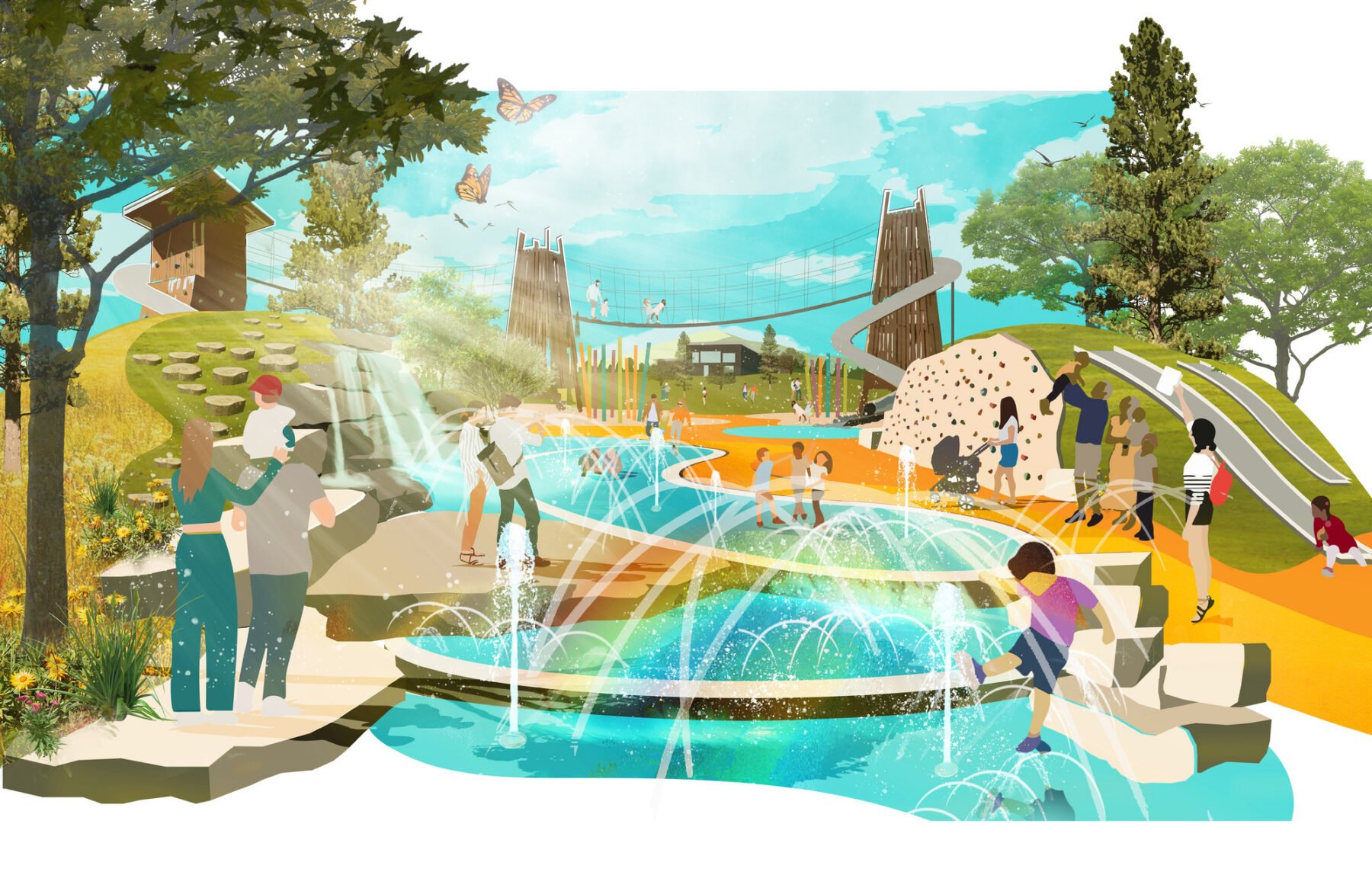
Renderings Sourced from Sasaki / City and County of Denver
The Park Hill Park Vision
The newly released framework plan establishes a high level structure for how the property could function in the coming decades. Rather than detailing final construction drawings, the framework defines the spatial organization, major amenity zones, and environmental systems that will guide phased implementation.
At the center of the plan is a continuous open space corridor that prioritizes ecological restoration and passive park use. Surrounding that central ribbon, higher activity areas are concentrated along edges and key corners of the property. Proposed amenities include multi use athletic fields and sports courts along Colorado Boulevard, a destination playground with interactive water features, outdoor adventure areas, and a field house. The existing clubhouse is envisioned as a renovated cultural hub for gatherings and programming.
A multi use loop trail system is planned to connect the entire site, linking recreational areas with restored open space. Additional features such as picnic pavilions, restrooms, and observation points are distributed throughout the park.
Stormwater management is a central component of the design. The framework proposes treating 100 percent of stormwater runoff on site through integrated strategies including a meandering creek bed, a flow through wetland, vegetative filtering, parking lot green infrastructure, and building runoff recapture. Located within the Cherry Creek–South Platte watershed, the site plays a broader role in regional water systems.
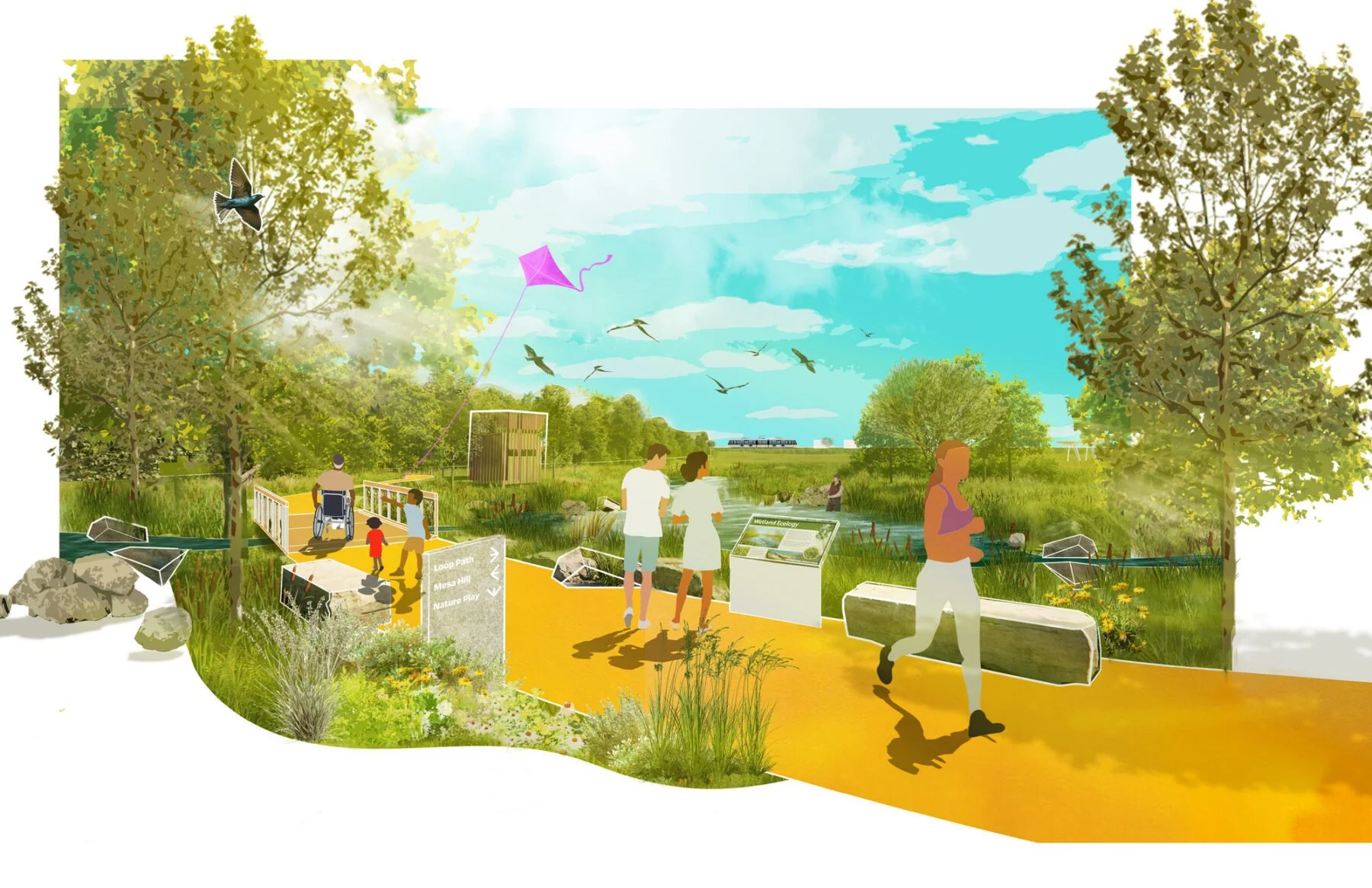
Renderings Sourced from Sasaki / City and County of Denver
The plan also emphasizes native habitat restoration and drought adapted landscaping to reduce irrigation demand while expanding tree canopy and supporting pollinator habitat.
Development of the framework was supported by eight major engagement efforts between August 2025 and January 2026, with input gathered through open houses, surveys, workshops, and community events. The project is backed by 70 million dollars in bond funding allocated through the 2025 Vibrant Denver Bond.
Detailed design, prioritization of amenities, and phasing strategies are the next steps before construction of initial improvements begins.
When complete, Park Hill Park will represent the largest addition to Denver’s park system in more than a century and a significant transformation of a site that has carried multiple identities over the past hundred years.

Renderings Sourced from Sasaki / City and County of Denver
Design Team Leading the Framework
The framework plan was developed for Denver Parks and Recreation by landscape architecture and urban design firm Sasaki, working in coordination with City staff and stakeholder groups.
Sasaki’s Denver office led the visioning and planning process, advancing the project from early conceptual “Big Ideas” into a preferred framework plan shaped by community input. The firm has previously worked on large scale park system planning efforts, including the Denver Parks Asset Condition and Park Quality Study, which informed long term capital priorities across the city’s nearly 6,000 acre park system.
For Park Hill Park, the design team synthesized public feedback, site constraints, watershed data, and ecological analysis to organize the 155 acre property into a central open space corridor surrounded by active recreation and community amenities. The framework establishes guiding principles that will continue shaping future design phases as detailed plans, engineering, and phasing strategies move forward.
All project information was sourced from publicly available site plans, renderings, and permitting documents.
See more behind the build on Denver’s greatest construction projects
Get a deeper dive on the who, what, when and why behind the city’s greatest construction projects with our premium member content.
Interested in sponsorship? Learn more about our sponsors and how to get involved.
All project information was sourced from publicly available site plans, renderings, and permitting documents.

5 minute read • A MODUS Broker Open will feature new details on Denver’s former VA hospital redevelopment, Dahlia Twelve and other development projects across the city.