
Denargo Market Beer Garden - Technical Zoning and Special Exception Case Study
Completed January 2026
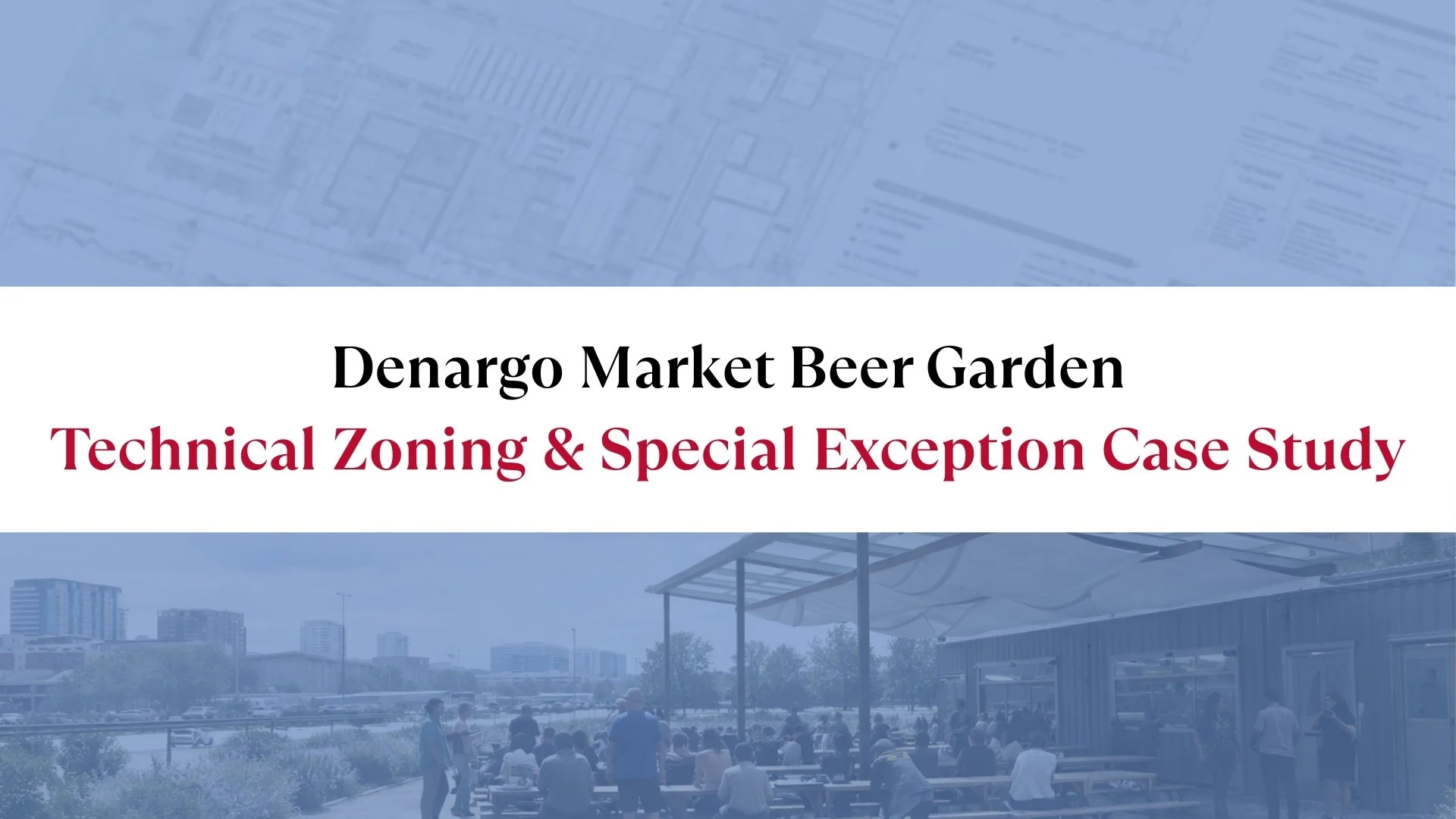
DENVER, CO – The Denargo Market Beer Garden is an outdoor activation project within the Denargo Market development area. The scope includes shade structures, refrigerated and storage containers, serving areas, perimeter fencing, site lighting, and temporary restroom facilities.
Although limited in enclosed building area, the project required coordination across multiple City agencies due to zoning requirements, site infrastructure interfaces, drainage considerations, and operational constraints. The project was reviewed under Building Log 2024-LOG-0012682 and processed as a zoning permit requiring a Special Exception Review, alongside concurrent DOTI SUDP and health department reviews.
Key Review Metrics
Building Log: 2024-LOG-0012682
Primary Address: 3380 Denargo St
Alternate Address Referenced: 2801 Chestnut Pl
Zoning District: C-MX-12, DO-7
Agencies Involved: Commercial Zoning (CZP), DOTI SUDP, Denver Department of Public Health & Environment
Review Cycles: Multiple zoning and SUDP resubmittals
Primary Delay Driver: Drainage documentation and inter-agency coordination
Final Status: Zoning Permit with Special Exception approved and issued
Regulatory Context
Despite being framed as an outdoor and partially temporary use, the project triggered several formal review processes:
Commercial Zoning Permit review addressing height, area, setbacks, fencing, and use compliance
Zoning Permit with Special Exception Review (ZPSE), requiring Board of Adjustment consideration
DOTI Sewer Use and Drainage Permit (SUDP), driven by drainage, imperviousness, and utility coordination
Health Department review focused on operational scope, sanitation, and restroom servicing
These reviews occurred in parallel, creating dependencies that directly influenced review sequencing and the overall approval timeline.
Permit Timeline and Review Progression
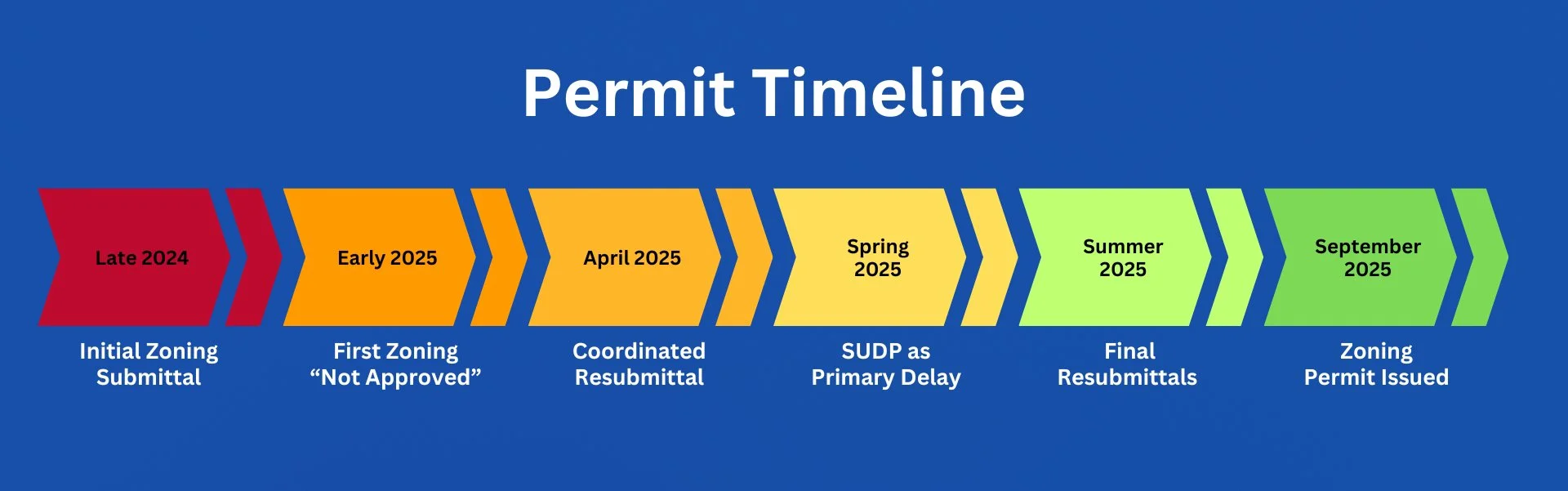
The project advanced through multiple coordinated submissions and resubmittals. Review focus shifted over time as documentation became more explicit and aligned across agencies.
Timeline Summary
Initial Submittal – Late 2024
The project was initially submitted under Building Log 2024-LOG-0012682 for zoning review. Early filings established the proposed outdoor use, general site layout, and operational intent but lacked sufficient detail to verify zoning compliance and downstream coordination.
First Zoning Review – Early 2025
Commercial Zoning issued a Not Approved determination, citing the need for clearer documentation related to structure heights, fencing, gates, setbacks, and overall site organization. Addressing inconsistencies were also identified at this stage.
First Coordinated Resubmittal – April 2025
A coordinated resubmittal addressed zoning comments and initiated parallel review with DOTI SUDP and the health department. This submission included revised drawings, written response logs, operational narratives, and supporting documentation. Health review advanced during this phase, while zoning and SUDP reviews remained open.
Subsequent Zoning Reviews – Spring 2025
Zoning reviews continued to return Not Approved determinations. Outstanding issues increasingly focused on documentation clarity rather than scope, including explicit dimensional callouts and confirmation of the required Zoning Permit with Special Exception Review.
SUDP Review Cycles – Spring to Early Summer 2025
DOTI SUDP reviews became the primary driver of the overall timeline. Multiple review cycles focused on grading and drainage documentation, including flow paths, discharge locations, plan consistency, and narrative confirmation that proposed improvements did not exceed previously approved imperviousness.
Final Resubmittals – June and July 2025
Final coordinated resubmittals consolidated zoning, civil, and operational responses. Drainage plans were fully annotated, elevations reconciled, and supporting narratives finalized, resolving remaining SUDP and zoning comments.
Zoning Approval – September 2025
Following completion of the Special Exception review and resolution of outstanding documentation items, the zoning permit was approved and issued, closing the review process under the building log.
Timeline Observations
Across the review period:
Early cycles focused on eligibility and compliance verification
Mid-cycle reviews emphasized documentation clarity and coordination
Final approvals were achieved once ambiguity was fully removed
No single redesign event defined progress. Advancement occurred through cumulative clarification and alignment.
Why the Timeline Matters
This timeline demonstrates how relatively small coordination and documentation issues can extend review duration when multiple agencies review in parallel. It also illustrates how review focus narrows as foundational questions are resolved.
Primary Delay Drivers
The project did not stall due to a single noncompliant element. Delays resulted from cumulative coordination and documentation issues across agencies.
Addressing and Record Consistency
Early filings referenced both 3380 Denargo St and 2801 Chestnut Pl. This inconsistency required clarification across zoning, SUDP, and addressing records and became a prerequisite for downstream approvals.
Observed impact:
Administrative inconsistencies created review friction unrelated to design intent or code compliance.
Zoning Review and Special Exception Trigger
Zoning reviews repeatedly requested explicit documentation of structure heights, fence and gate dimensions, and spatial relationships. In addition, the proposed use required a Zoning Permit with Special Exception Review, introducing a Board of Adjustment dependency that extended the approval path.
Observed impact:
Elements assumed to be self-evident still required precise dimensional callouts and formal process compliance.
SUDP Review as the Long Pole
DOTI SUDP reviews ultimately drove the overall timeline. Repeated comments focused on documentation rather than engineering feasibility, including:
Explicit drainage narratives
Clear identification of flow paths and discharge points
Alignment between grading plans, drainage details, and operational assumptions
Confirmation that proposed improvements did not exceed previously approved imperviousness
Drainage calculations were not the issue. Approval followed once drainage intent was fully documented and ambiguity was removed.
Observed impact:
SUDP reviews prioritized explicit documentation and reviewer certainty over design efficiency.
Plan Evolution: Early vs Final Submittals
The overall site concept remained consistent throughout the review process. The most significant evolution occurred in supporting documentation, particularly grading, drainage, and zoning clarity.
Grading and Drainage Documentation
Early submittals
General drainage intent shown
Flow paths and discharge locations present but not fully explicit
Limited narrative tying improvements to previously approved infrastructure
Final approved submittals
Area drains clearly tied to roof and surface drainage
Pipe sizes, slopes, and flow directions explicitly labeled
Daylight outfall details refined to remove reviewer ambiguity
Finished Floor Elevations reconciled across containers and structures
Drainage memo confirming no increase in imperviousness
Observed change:
The drainage strategy did not materially change. The documentation did.
Site Plan and Zoning Clarity
Early submittals
Site elements shown but inconsistently dimensioned
Fence, gate, and height information not uniformly called out
Final approved submittals
Heights, areas, and setbacks clearly dimensioned across multiple sheets
Fence and gate heights explicitly labeled in plan and elevation views
Zoning-related elements aligned across drawings and response logs
Observed change:
Zoning compliance was achieved through redundancy and explicitness, not redesign.
What Did Not Change
Across all review cycles:
The overall site layout remained consistent
The use and operational intent did not materially change
Impervious area remained within previously approved limits
No major scope reduction was required
This indicates the review process focused on clarity and confirmation rather than project feasibility.
Outcome: Zoning Special Exception Approval
Following completion of zoning, SUDP, and health department reviews, the Denargo Market Beer Garden was approved through a Zoning Permit with Special Exception Review.
The Board of Adjustment staff report recommended approval based on compliance with Section 12.4.9.3 of the Denver Zoning Code, citing consistency with Blueprint Denver, the intent of the C-MX-12 zone district, and the approved Denargo Market General Development Plan.
Approval focused on operational controls rather than physical redesign. Conditions addressed hours of operation and noise limits to mitigate potential impacts on adjacent residential uses.
The zoning permit (2024-ZONE-0005258) was issued on September 5, 2025, closing the zoning review process under Building Log 2024-LOG-0012682.
Implications for Future Projects
Outdoor and partially temporary uses can still trigger full zoning review, including Special Exception processes, when located in mixed-use or residential-adjacent contexts.
Zoning Permit with Special Exception approvals are often resolved through operational controls, such as hours of operation and noise limits, rather than physical redesign.
DOTI SUDP review timelines are frequently driven by documentation clarity and inter-sheet consistency, not drainage capacity or system feasibility.
Addressing and administrative inconsistencies can become gating items across multiple agencies and delay downstream approvals.
Parallel agency reviews increase coordination risk when zoning, civil, and operational documentation are not fully aligned at initial submittal.
All project information was sourced from publicly available site plans, renderings, and permitting documents.
See more behind the build on Denver’s greatest construction projects
Get a deeper dive on the who, what, when and why behind the city’s greatest construction projects with our premium member content.
Interested in sponsorship? Learn more about our sponsors and how to get involved.
All project information was sourced from publicly available site plans, renderings, and permitting documents.

5 minute read • A MODUS Broker Open will feature new details on Denver’s former VA hospital redevelopment, Dahlia Twelve and other development projects across the city.