
Inside the Broncos’ Burnham Yard Stadium Proposal as LDR Process Moves Forward
DENVER, CO – The Denver Broncos presented updated details for their proposed new stadium and mixed use district at Burnham Yard during a February 12 Community Information Meeting, formally advancing the project through Denver’s Large Development Review process.
The 150 acre site, located south of downtown near the 10th and Osage RTD Station, is envisioned as a transit oriented “Stadium Neighborhood” that would extend the city grid into the former rail yard and integrate residential, retail, entertainment, office, hospitality, and civic uses around a new NFL stadium.
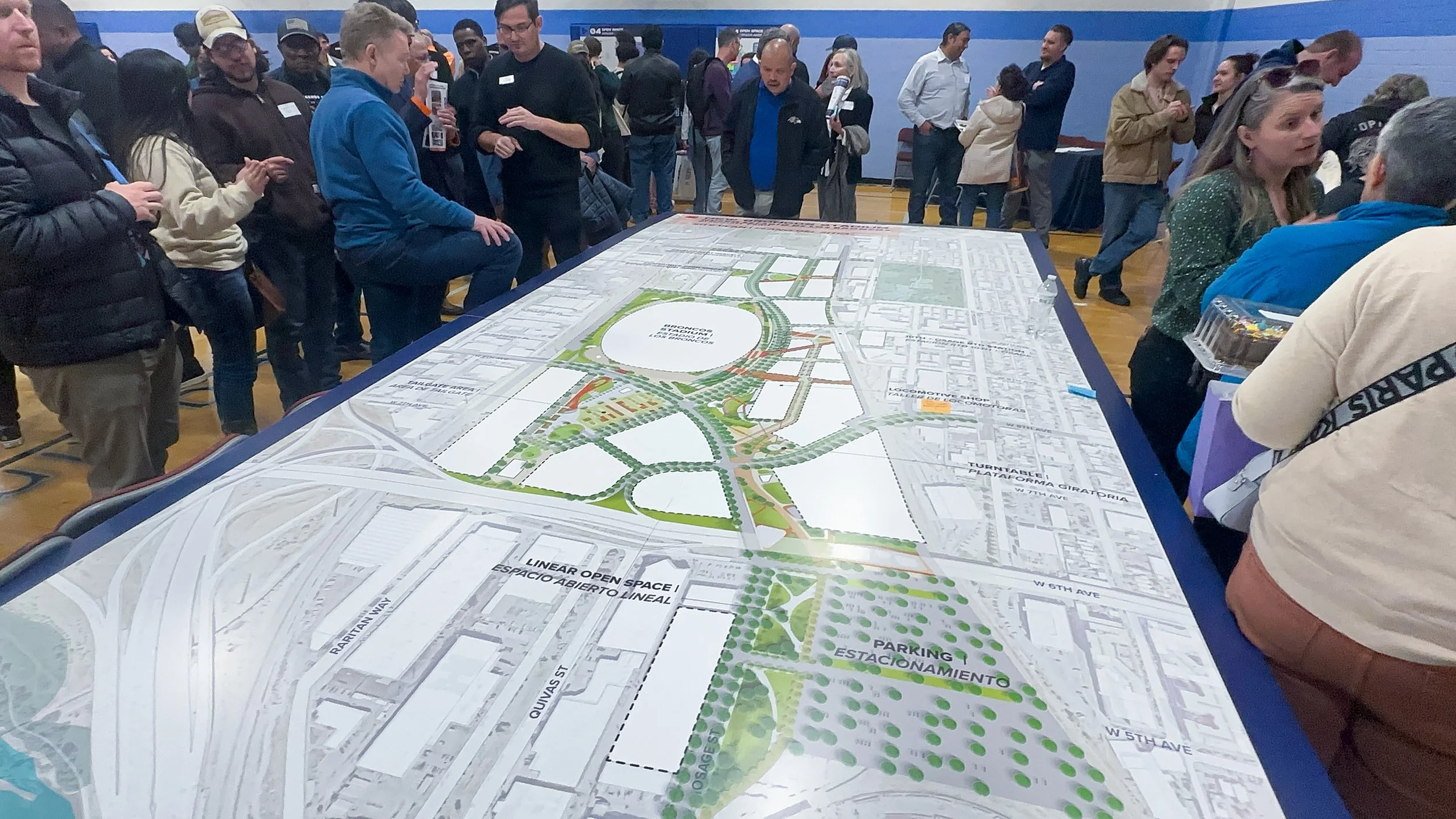
Photo take during Community Input Meeting | Developing Denver
Site + Zoning Context
City staff confirmed the site is currently zoned Industrial and Industrial Mixed Use. Stadium and surface parking are already allowed under existing zoning, but a rezoning is anticipated to enable the broader mixed use and residential vision outlined by the team.
Preliminary Large Development Review findings indicate that rezoning is encouraged to support mixed use and housing, that at least 10 percent open space will be required, and that mobility improvements will be necessary given the scale of redevelopment.
No formal approvals have been granted. The project is moving forward alongside a Burnham Yard Small Area Plan, which will guide broader policy decisions for the surrounding area.
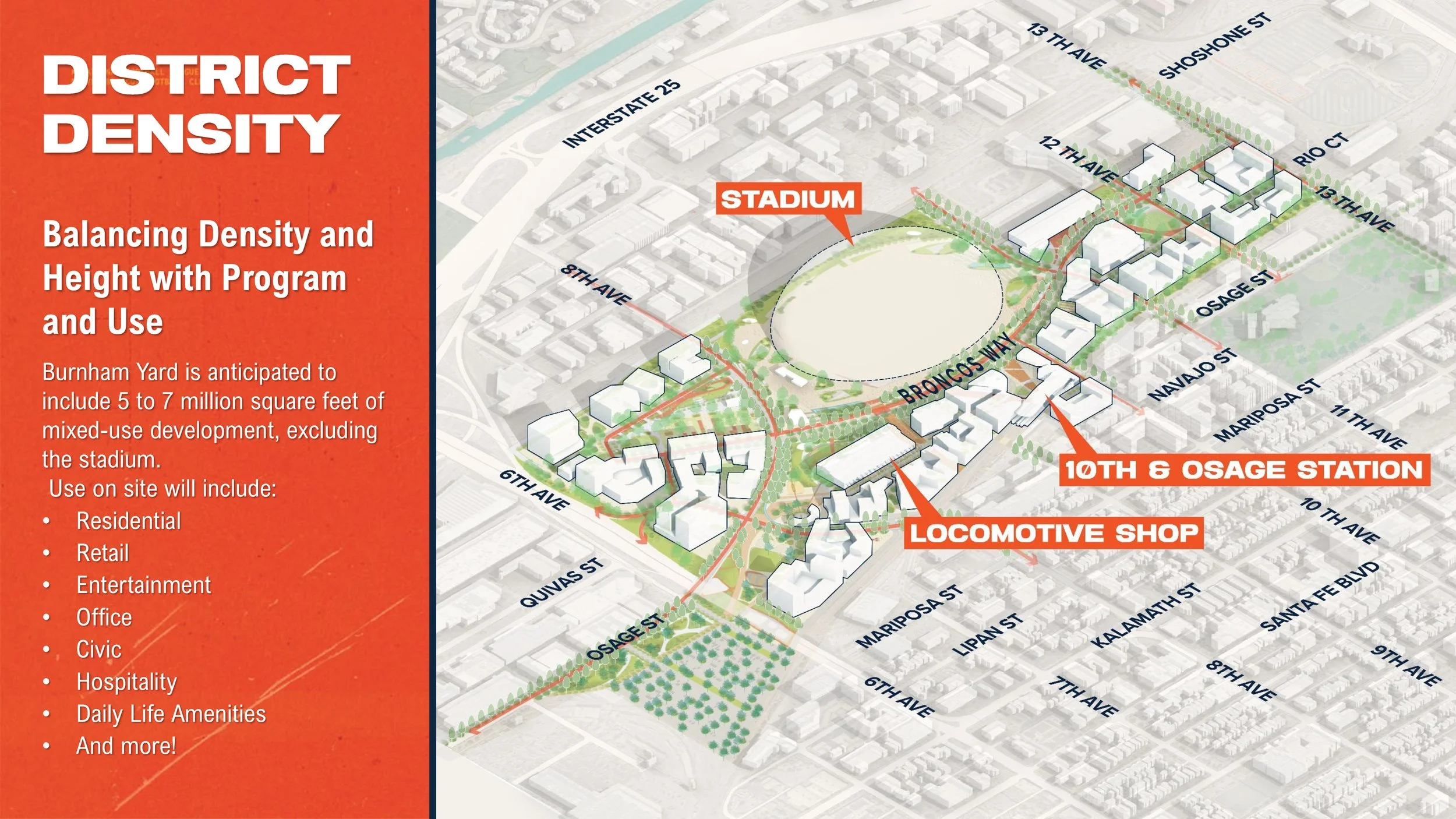
Photo Sourced from Denver Broncos’ Community Input Meeting Presentation
Master Plan Vision
The Broncos and their consultant team outlined five primary master plan moves:
Place the stadium on the western side of the site to reduce visual and noise impacts on La Alma Lincoln Park and the Santa Fe Arts District.
Extend the city street grid into Burnham Yard to reconnect east and west neighborhoods.
Develop distinct character zones across the 150 acre site.
Connect the historic Locomotive Shop to the neighborhood via 10th Street.
Establish a network of interconnected public open spaces exceeding 15 acres.
The development program anticipates 5 to 7 million square feet of mixed use development, excluding the stadium itself. Character zones include the North Neighborhood, Stadium District, Entertainment District, Stadium South, and South Neighborhood.
Building heights would be moderated along the eastern edge to transition to adjacent residential areas, with taller buildings concentrated toward the north and south to preserve view corridors, including the State Capitol view plane.
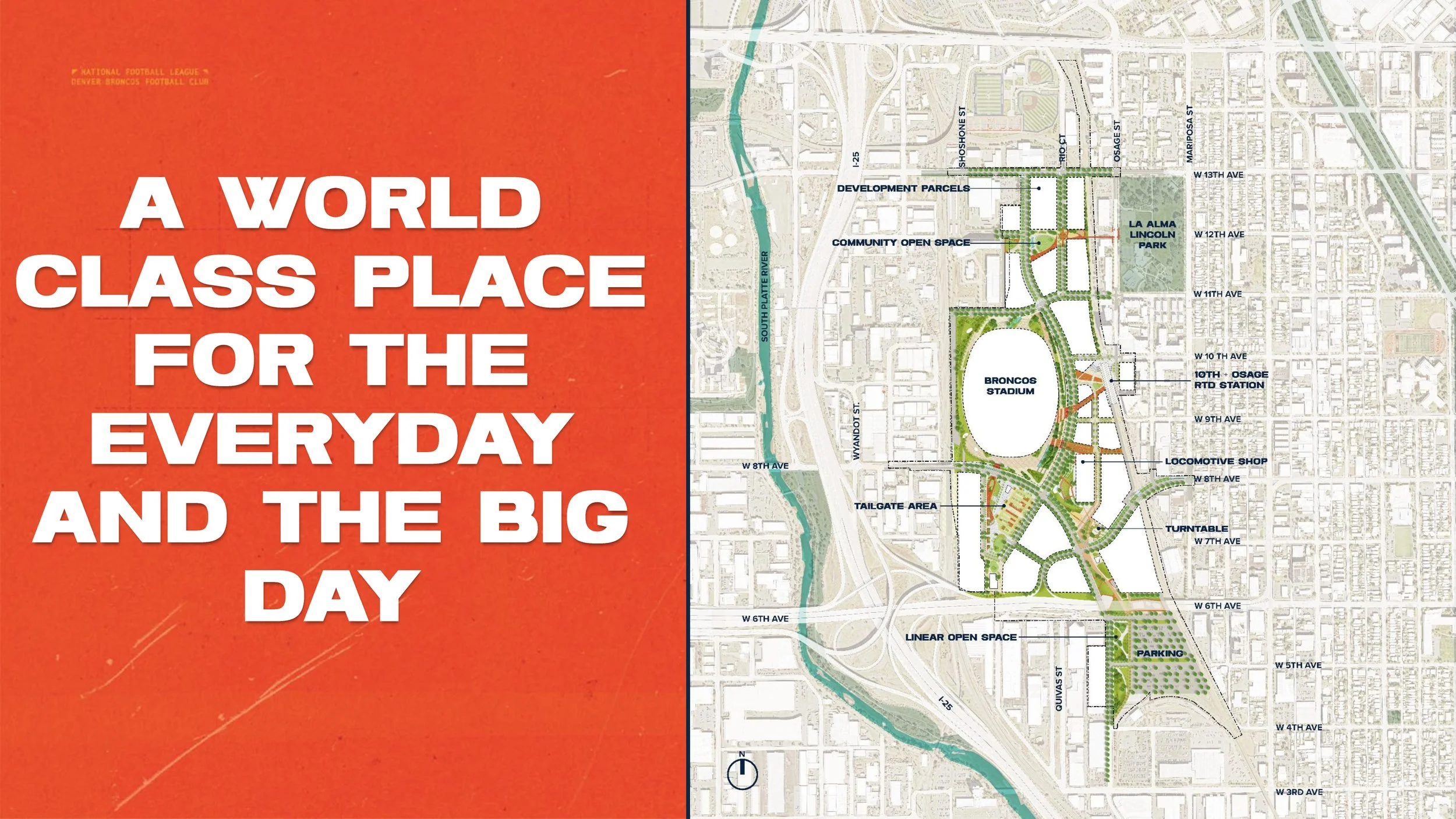
Photo Sourced from Denver Broncos’ Community Input Meeting Presentation
Open Space + Public Realm
At least 15 acres of open space will be designated across the site, with planners indicating their intent to exceed the minimum requirement.
The open space strategy includes promenades, plazas, an event lawn, playgrounds, and green corridors that connect to existing assets such as La Alma Lincoln Park, the South Platte River Trail, and Cherry Creek Trail.
The goal is to transform the former rail yard into an interconnected network of public spaces that function both on game days and throughout the year.
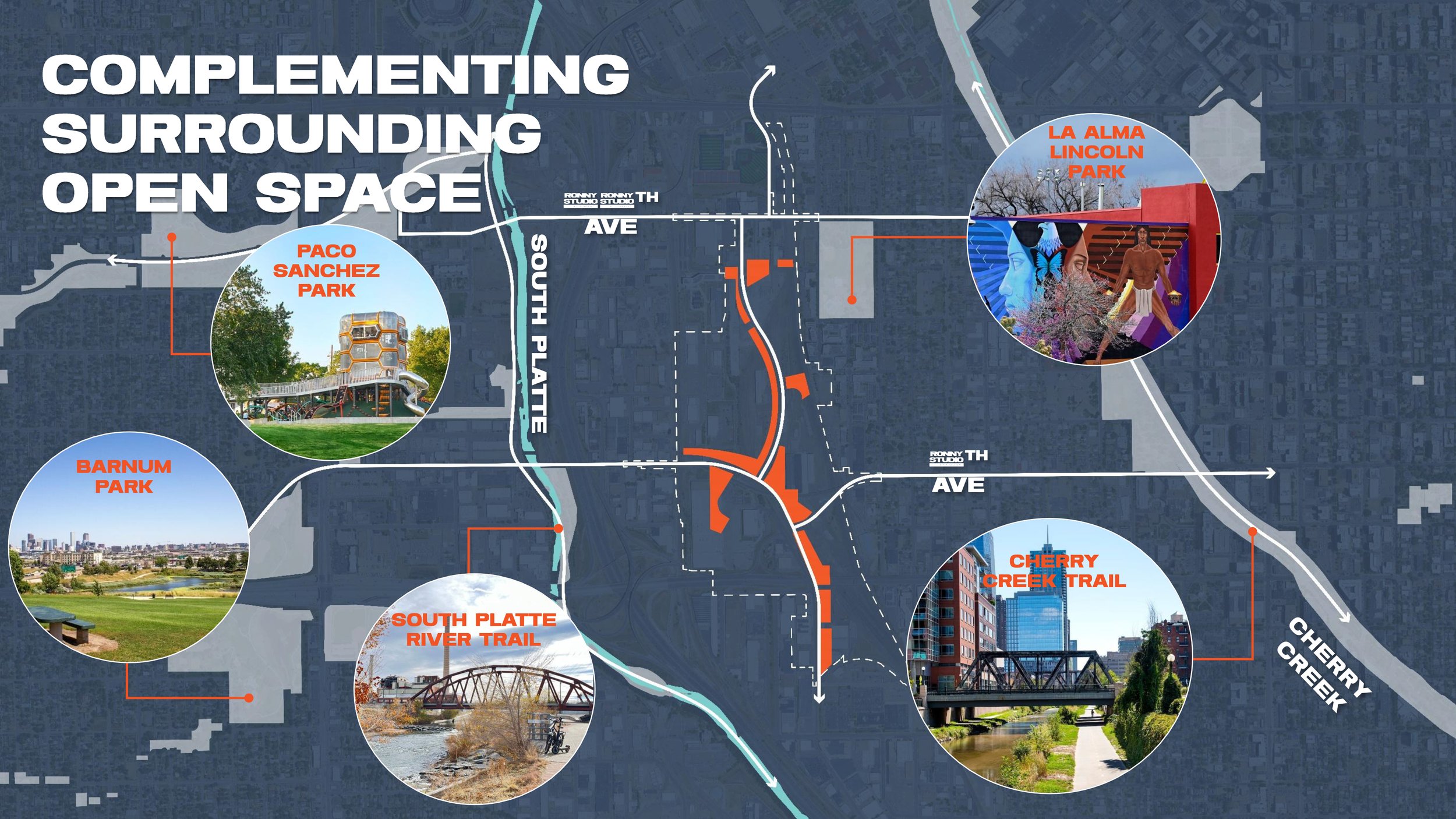
Photo Sourced from Denver Broncos’ Community Input Meeting Presentation
Mobility + Transit Integration
A major emphasis of the presentation focused on transit and access. Plans call for:
An integrated street, sidewalk, and transit network
Enhancements to the 10th and Osage light rail station
Grade separated pedestrian and bicycle crossings at key intersections
A shared parking strategy embedded within mixed use development
Event day traffic management to prevent cut through traffic in surrounding neighborhoods
The project will require coordination with RTD, CDOT, Denver Water, and potentially future Front Range Passenger Rail planning.
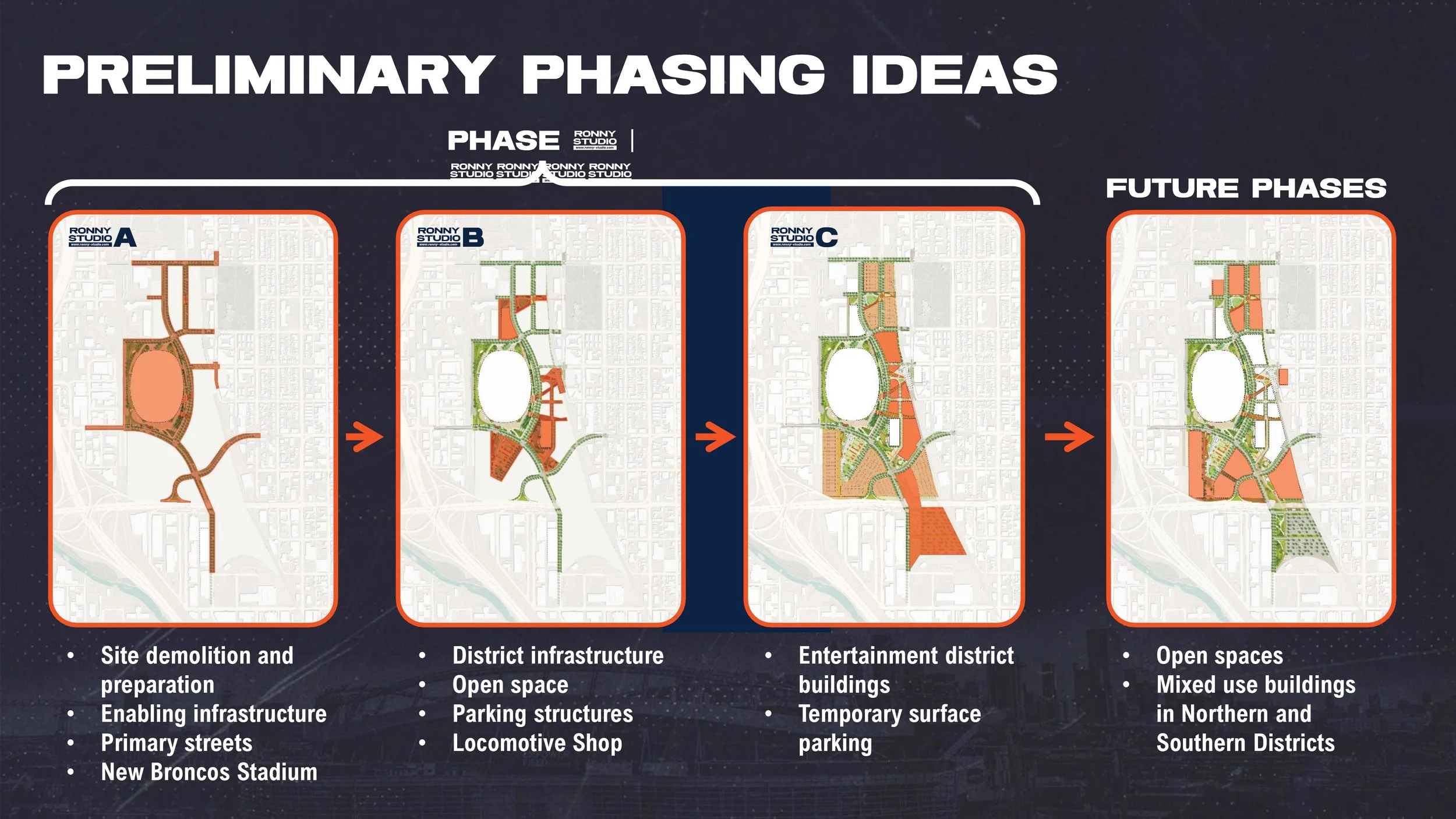
Photo Sourced from Denver Broncos’ Community Input Meeting Presentation
Phasing + Timeline
Development is expected to occur in phases.
Phase 1 would include site demolition and preparation, enabling infrastructure, primary streets, the new Broncos Stadium, district infrastructure, open space, parking structures, adaptive reuse of the Locomotive Shop, and initial Entertainment District buildings.
This first phase is targeted for completion in spring 2031.
Future phases would include additional mixed use development in the Northern and Southern neighborhoods.
Design work is anticipated to begin in 2026 and continue into 2027, with construction potentially starting in 2027 or 2028.
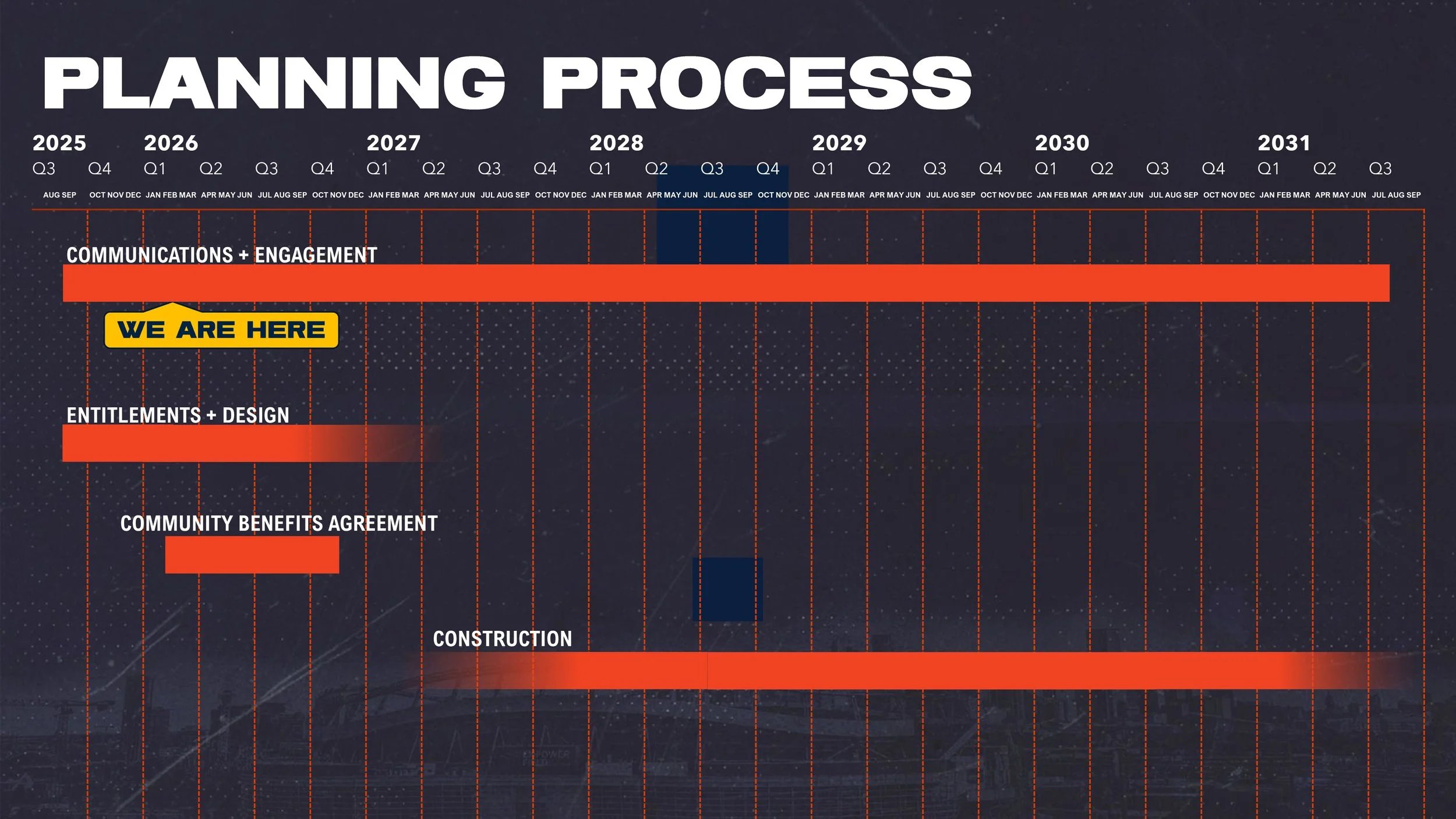
Photo Sourced from Denver Broncos’ Community Input Meeting Presentation
Community Engagement + Benefits Agreement
The Broncos confirmed that a Community Benefits Agreement process is underway and will run in parallel with entitlements and design. Additional public meetings and engagement sessions are expected as the project advances through rezoning, infrastructure planning, and city approvals.
The Burnham Yard proposal remains in the early stages of review, with citywide plans, the Small Area Plan process, and Large Development Review all shaping the next phase of decision making.
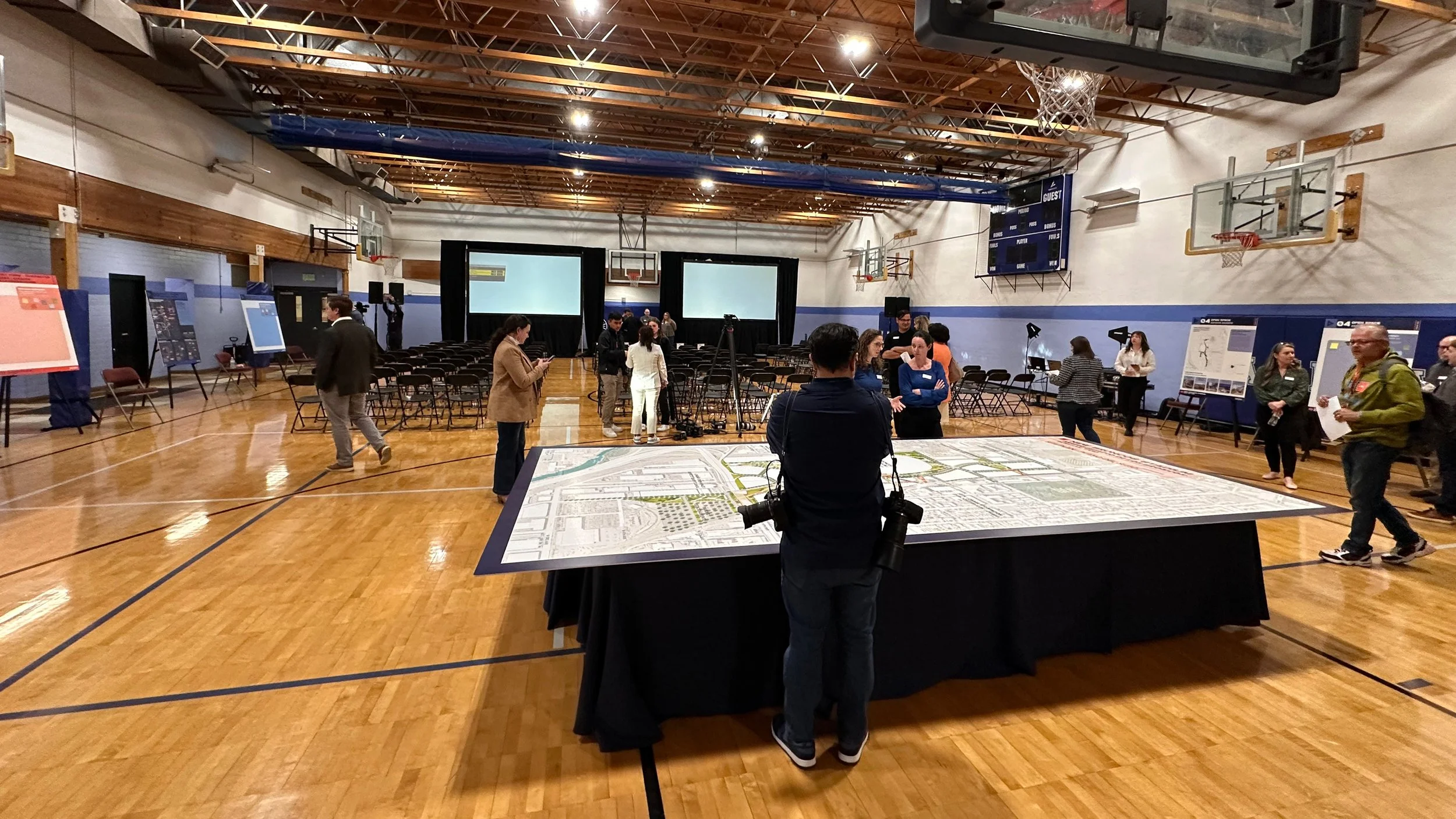
Photo take during Community Input Meeting | Developing Denver
All project information was sourced from publicly available site plans, renderings, and permitting documents.
See more behind the build on Denver’s greatest construction projects
Get a deeper dive on the who, what, when and why behind the city’s greatest construction projects with our premium member content.
Interested in sponsorship? Learn more about our sponsors and how to get involved.
All project information was sourced from publicly available site plans, renderings, and permitting documents.

5 minute read • A MODUS Broker Open will feature new details on Denver’s former VA hospital redevelopment, Dahlia Twelve and other development projects across the city.